
AI Answer Benchmarking: How to Measure Your Brand’s Position
AI answer benchmarking measures how often AI assistants mention, cite and accurately describe your company when buyers ask the questions that lead to a purchase, and how that compares with the competitors the same answers name. It is not the same as benchmarking AI models. You are scoring your market position inside the answers, not the model’s intelligence. Done well, it tells you where buyers meet competitors instead of you. Authority Engine manages the strategy and execution that moves those numbers for established companies, and the method below is the one to hold any benchmark to, whoever runs it.
TL;DR
- AI answer benchmarking scores your brand inside AI-generated answers to buyer questions: mentions, citations, accuracy and share of voice against named competitors.
- Public model benchmarks (coding, reasoning, summarization tests) answer a different question. They tell you which model to build on, not whether buyers see you.
- A number only means something when the question set, engines, country, number of runs and the definition of a “mention” are fixed and disclosed.
- AI answers change from run to run, so read trends across repeated scans, never from two adjacent data points.
- The point of the benchmark is a ranked list of gaps: missing content, sources that win citations instead of yours, and wrong facts to correct.
Table of Contents
- Two meanings of the phrase, and which one you need
- The metrics that make up a benchmark
- Building the question set
- Running comparable scans
- Reading the results without fooling yourself
- Turning the benchmark into a work plan
- How often to benchmark
- Start with your own position
- FAQ
- Sources
Two meanings of the phrase, and which one you need
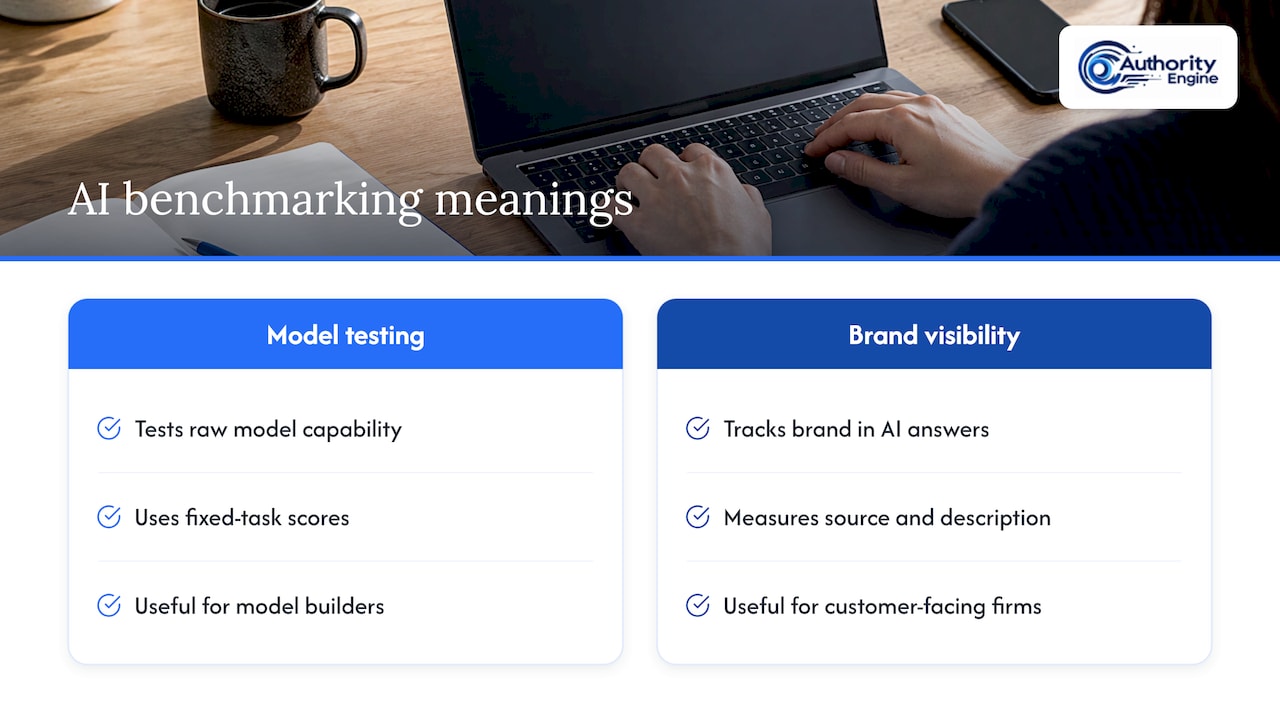
Search for this phrase and most results are about testing AI models: leaderboards, task suites and scores. One engineering guide separates public benchmarks that score a model’s raw capability on fixed tasks from evaluations written against your own data, and notes that benchmark scores do not reliably predict how a system performs in your own setting. That is useful if you are building software on a model.
If you run a company whose customers research before they buy, you need the other meaning. A buyer asks an assistant which providers to shortlist, how two approaches compare, or who is credible in your category. The assistant writes an answer that names some companies and leaves out others. Benchmarking that answer means asking: how often are we in it, with what source, described how, and next to whom?
This matters because a company can be the right choice and still lose the consideration stage. If the buyer’s first research step ends with a competitor’s name, you never learn there was a shortlist. A benchmark makes that invisible step visible.
The metrics that make up a benchmark
Resist a single blended score. Each metric describes a different part of the problem, and the Interactive Advertising Bureau’s August 2026 report on measuring visibility in the AI era gives the clearest standard definitions.
Mention rate
Mention rate is the share of AI responses that contain your brand, out of all responses across a defined set of queries. The same IAB report stresses that results are sensitive to which queries you choose, so two companies can report very different rates for the same brand simply by choosing different questions. A worked example: one published formula divides answers mentioning your brand by total answers for your space and multiplies by 100, so 22 mentions in 100 responses is a 22% score.
Citation rate
Citation rate is the share of responses that cite your brand as a source, either with a link or with a named reference. The IAB treats the gap between the two as informative: a high mention rate with a low citation rate means assistants know you exist but are drawing their facts from other pages. For a marketer, that points toward the third-party coverage and your own pages that the answer actually relies on.
Accuracy
Being named is only useful if the description is right. The IAB separates two failure types. A hallucination is a brand association the AI invented with no source behind it. A factual inaccuracy is the AI faithfully repeating wrong content that exists somewhere on the web. The first is a platform quality issue; the second is something you can fix at the source, such as an outdated pricing page, a stale directory listing or an old press article. Report them separately, and per platform.
Share of voice and position
Share of voice compares your mentions with the total brand mentions in the category. The IAB asks providers to disclose how the competitive category is defined and how the total mention count is computed, because both choices change the result materially. If a report shows a share-of-voice figure without saying which brands make up the category, you cannot judge it.
A useful fifth reading is stance: whether the answer puts you forward for the task, with your conditions intact (“best for mid-market teams”), or lists you as one name among ten.
Building the question set
The question set is the measurement. Everything else is arithmetic. Build it like this:
- Write questions the way a buyer types them while deciding. Use problem questions (“how do I reduce churn in a subscription business”), comparison questions (“X versus Y approach”), and provider-evaluation questions (“how to choose a firm for …”). Draw wording from sales calls, support tickets and the questions prospects ask before they book.
- Keep branded and unbranded questions apart. A question that names your company will mention you almost every time. Pooling it with category questions can hide the fact that you are absent when buyers do not yet know your name.
- Cover the whole journey. Include early research, comparison and “who should I contact” questions, so you see where in the decision you drop out.
- Freeze the set. Once the first scan runs, do not edit the wording. If you add questions, start a new series and do not compare it with the old one. Log every change.
- Size it to the decision. A few dozen well-chosen questions per market beats hundreds of vague ones. What matters is that they represent how your buyers actually research.
This is where a business owner’s own knowledge matters most, and where many internal efforts stall: the questions that move revenue are specific to your customers, not to your category in general. Authority Engine’s managed service starts with buyer-question and semantic research for exactly this reason.
Running comparable scans
Two visibility numbers are comparable only when they share the same definition, prompts, engines, country, number of runs and standard for what counts as a mention. Fix each of these before the first scan.
Engines. Cover the platforms your buyers use, such as ChatGPT, Perplexity and Google’s AI search experiences. Report each engine on its own. A strong result on one and a weak result on another are two findings, not two inputs to average. Different platforms retrieve and cite sources differently, which is why how AI search platforms work shapes what you do next.
Conditions. Ask from the same country and language, in the same type of session, in the same collection window. A logged-out session is a clean baseline, but it will not mirror every individual buyer, whose history can change the answer.
Repeats. Ask each question several times per engine per cycle. AI answers are not fixed: the same prompt can produce different responses on different runs, so a single answer proves little. Count a brand once per question, not once per run, so a question that is asked five times does not weigh five times as much.
Competitor set. Benchmark against the companies the AI actually names most often for your questions, not only the ones your sales team worries about. They are sometimes different, and the gap is a finding in itself. Our guide to competitor visibility analysis covers how to choose that set.
A simple record per observation keeps the benchmark auditable: question, engine, date, whether you were mentioned, whether you were cited and to which URL, what was said, and who else appeared. Keep the supporting sentence with each observation so someone can check the reading later.
Reading the results without fooling yourself
Most bad decisions come from over-reading small movements. Three habits prevent that.
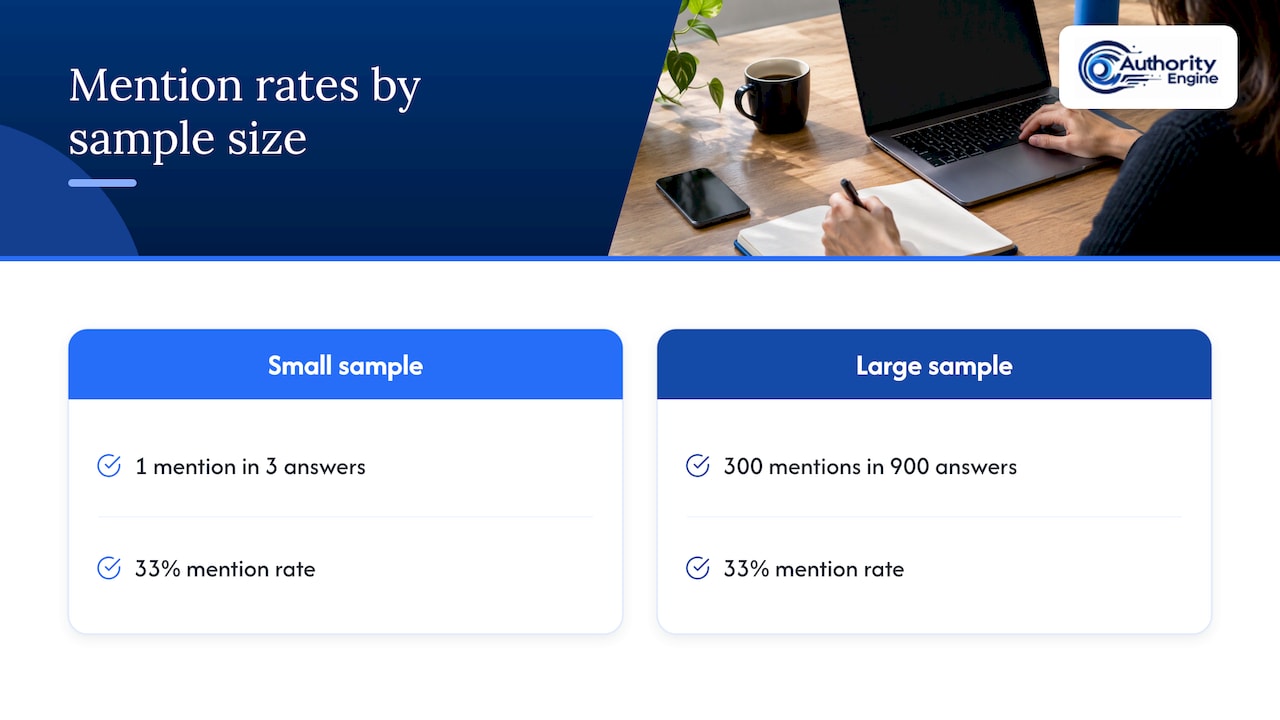
Read counts before rates. One mention in three answers and 300 in 900 are both 33%, but only the second tells you anything. Always show the count beside the percentage.
Do not trust adjacent points. Because answers vary between runs, a jump from one week to the next may be nothing but variation. Judge change across several scans, and treat small differences as noise until they persist. The same discipline applies to any tracking data; avoiding misleading conclusions in visibility tracking is a useful frame for it.
Do not use universal “good score” bands. A figure that looks weak in a crowded category may be the top position in a narrow one. The meaningful comparison is your rate against the leading brands on the same questions, engines, country and period.
Be equally careful about what a mention is not. A mention is not a recommendation, a click, a lead or a sale. The benchmark measures consideration, which is the stage before the sales conversation, and it should be paired with your own pipeline data rather than substituted for it.
Turning the benchmark into a work plan
A benchmark earns its cost when it produces priorities. Start with the question segments where you are weakest, then open the answers and look at which pages the engine cites. Classify each gap:
| Gap type | What you see | Typical response |
|---|---|---|
| Coverage gap | No page anywhere answers the buyer’s question well | Create strategic content that answers it directly |
| Citation gap | Content exists, but other sources are cited instead | Strengthen external credibility, contextual backlinks and community presence |
| Platform gap | Strong on one engine, weak on another | Adjust sources and formats for the weaker platform |
| Accuracy gap | Wrong or outdated facts about you | Correct the underlying page, listing or article |
Prioritize by business relevance and repeatability. Do not chase every missed prompt: fix the questions that sit closest to a buying decision and that fail consistently across scans.
Two supporting practices help. First, track brand mentions across the web and in AI answers, since third-party pages often feed what the assistants say. Second, review your own site for barriers that stop engines from reading and citing it; our AI discoverability plan walks through them. For a staged approach to the whole effort, see the 90-day AI visibility audit.
How often to benchmark
Run a baseline first, then repeat on a fixed schedule, with monthly as a practical rhythm for most established companies. Keep the question set frozen inside each series, and only start a new series when the market or your offer changes enough to justify new questions. Report each engine separately and keep a change log so that a movement can be tied to something you did, such as a new comparison page or a placement in a respected publication.
Our perspective
Benchmarks are often treated as the product. We see them as the starting line. A dashboard that tells you your mention rate fell does not change what a buyer reads tomorrow.
Our approach combines commercial strategy with doctoral research, because the hard part is judgment: which buyer questions deserve your effort, which gaps are about missing content and which are about credibility, and how to build authority that engines and buyers both trust. We don’t just track mentions. We manage the strategy and execution that strengthen your opportunity to compete for customers before they ever contact sales.
That is why we pair measurement with the work itself: buyer-question research, content that answers those questions, relevant contextual backlinks, useful community participation, executive LinkedIn content and continuous refinement. The benchmark tells you where you stand. The managed work changes it.
Dr. Patrick McAvoy
Start with your own position
If you want to see where you stand before committing to anything, the AI Visibility & Revenue Opportunity Report gives you a personalized view of your current position when buyers use AI to research and compare providers.

For established companies that want the gaps closed rather than just charted, Managed AI Visibility covers the ongoing strategy, content, authority-building, monitoring and refinement, with monthly site-health recommendations for your team to implement.
FAQ
Is AI answer benchmarking the same as benchmarking AI models?
No. Model benchmarks score a model’s capability on fixed tasks, which helps engineers choose a model to build on. AI answer benchmarking scores how your company appears inside the answers buyers receive: whether you are mentioned, cited, described accurately and compared with competitors.
How many questions do I need?
Enough to represent how your buyers research across the whole journey, from problem questions to provider comparisons, and no more than you can keep frozen and repeat. A few dozen carefully chosen questions per market usually tell you more than a large, loosely worded list. Keep branded questions in a separate set.
Why do my results change between scans?
AI assistants can give different answers to the same prompt on different runs, and platform updates shift behavior too. That is why you ask each question several times, report counts beside percentages, and read the trend across repeated scans rather than from two neighboring results.
What is a good mention rate?
There is no universal threshold. A good result depends on your category, the question mix and which brands the engines name most often. Compare yourself with the leading brands on identical questions, engines, country and period, and watch whether the gap narrows over time.
Does a mention in an AI answer mean a buyer will contact us?
Not by itself. A mention shows you entered consideration; it is not a recommendation or a lead. Combine the benchmark with your pipeline and sales data to see how visibility connects to inquiries.
Sources
- IAB: Measuring Visibility in the AI Era (August 2026)
- Search Engine Land: How to measure your AI search brand visibility
- LangChain: Evaluating LLMs and Agents
- Maprank: How to Measure Local Visibility