The B2B Buyer Journey in the Age of AI: Where Shortlists Form
The B2B buyer journey now runs through AI assistants before it reaches your sales team. Buyers use them to scope a problem, surface vendors, compare providers and pressure-test a shortlist, and most of that happens where you cannot see it. The companies that win are the ones AI describes accurately and buyers already trust when sales finally gets the call. That is a visibility and credibility job, and it is the work we do at Authority Engine for established companies.
TL;DR
- Seventy percent of U.S. decision-makers in a 2026 Ipsos study use AI in vendor selection, and 42% say it produces vendors they would not otherwise have considered.
- AI shows up at every stage, but its strongest role is mid-evaluation: comparing, summarizing and narrowing a list.
- Most buyers arrive at first sales contact with criteria set and a favorite chosen, so the shortlist is won before you know there is a deal.
- Trust is built by consistent proof across independent sources, not by your own website alone.
- Measure visibility as a rate across many AI answers and track buyer-reported attribution, not a single screenshot.
Table of Contents
- How the B2B buyer journey works now
- Where AI enters each stage
- What the data says about discovery and shortlists
- Why trust decides who stays on the list
- What to do about it: a practical plan
- Where this work usually stalls
- See where buyers meet you first
- FAQ
- Sources
How the B2B buyer journey works now
The classic model has three stages: awareness (the buyer realizes there is a problem), consideration (the buyer evaluates options) and decision (the buyer picks). That structure still holds. What changed is where each stage happens and who is in the room.
In the Reddit and SurveyMonkey study of U.S. business decision-makers, 83% researched on their own before ever speaking to sales, and 55% struggled to know which sources to trust. In Ipsos’s 2026 U.S. report, 77% said vendor research is the most time-consuming stage, because that is where teams compare vendors, validate claims and build confidence in a shortlist.
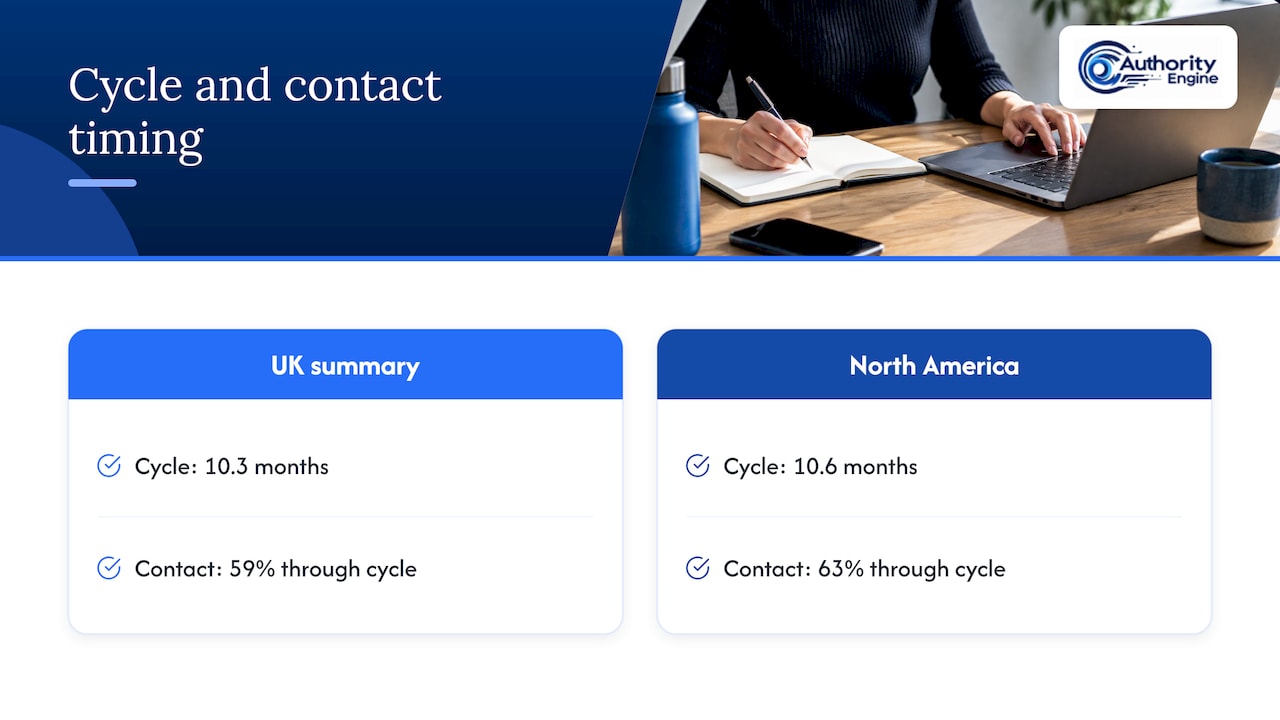
Timing matters as much as behavior. In 6sense’s 2026 data, as reported in a UK-focused summary of the study, buyers made first seller contact roughly 59% of the way through an average 10.3-month cycle, and 63% of the way through a 10.6-month cycle in North America. By then, the group has usually done most of its thinking. If your company was not part of that early research, a good sales team arrives late to a conversation that is already shaped.
Where AI enters each stage
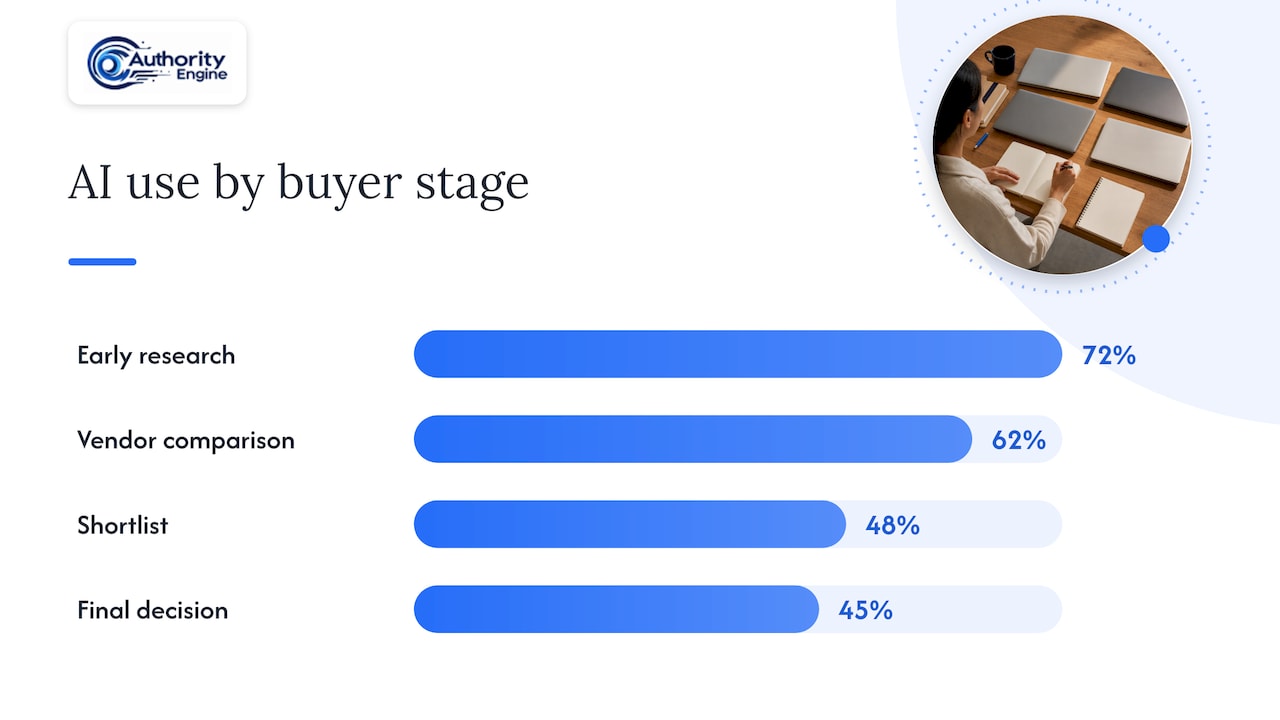
AI is not a single step in the journey. It threads through all of it. A Semrush survey of U.S. B2B professionals (March to April 2026) found 72% use AI in early research and scoping, 62% when comparing vendors, 48% to narrow the shortlist and 45% to support the final decision.
Here is how that plays out in practice.
| Stage | What the buyer asks AI | What it means for you |
|---|---|---|
| Problem awareness | “Why is our pipeline stalling?” “What causes X?” | Your expertise needs to exist in public, citable form, not only in sales decks |
| Solution research | “What types of providers solve this?” | Category explanations should name your approach and the criteria you want buyers to use |
| Vendor comparison | “Compare providers for [need] in [industry]” | Comparison content, third-party mentions and reviews decide whether you appear |
| Shortlist and validation | “Is [vendor] credible? What do customers say?” | Consistent proof across independent sources, and accurate facts about you |
| Decision | “What should we ask in the demo?” | Your answers must hold up against what AI has already told the committee |
The research on how buyers open these conversations is telling. A Wynter study of 200 B2B buyers found that 62% start AI vendor research with a plain category question that names no vendor, even though 80% already had one in mind. Two-thirds said the AI put a vendor they had not considered on their shortlist. An open category question is a shortlist-building event, and you either appear in it or you do not.
What the data says about discovery and shortlists
The evidence agrees on direction and differs on magnitude, which is worth being honest about.
AI as a discovery engine. Ipsos found 70% of U.S. participants use AI in vendor selection and 42% say it generates an initial vendor list they would not otherwise have considered. IDC’s September 2026 analysis reports that 46% of B2B buyers turn to AI tools to evaluate vendors, while use of vendor websites as an evaluation source fell from 66% to 37%. Your website is no longer the first place buyers learn about you.
AI as a shortlist influencer. G2’s 2026 AI search report finds AI chatbots are the top source influencing which vendors make buyer shortlists, at 54%, and that 85% of software buyers think more highly of a vendor cited in an AI answer. The same report says 69% of software buyers were led by a chatbot to a different vendor than they first planned.
AI as a sense-making tool. Not every study frames AI as a starting point. 6sense’s November 2026 research finds 81% of buyers use AI at some point in an active evaluation, but only 26% use it to discover new vendors, with most use mid-evaluation to compare and summarize. It also finds 81.5% ultimately buy from their favorite before contact.
These views fit together. Buyers carry prior impressions into the process, and AI then tests those impressions, summarizes the field and sometimes adds a name. For a marketing leader, the practical takeaway is the same either way: you need to be remembered before the search and be described well during it. Our guide to how buyers use AI in research goes deeper on the behavior itself.
Why trust decides who stays on the list
Getting named is the first hurdle. Staying on the list is the second, and trust governs it.
Ipsos reports that U.S. B2B buyers trust AI-generated summaries of products slightly more than documents provided by vendors, and that nearly half of respondents’ organizations use AI to evaluate and validate vendor options. Your own brochure is competing with a summary of what the wider web says about you.
Buyers do not simply accept what AI says. In G2’s interview study of 335 buyers, 75% default to cross-checking AI outputs across sources and 85% prefer proof beyond AI. When AI gets a vendor’s information wrong, 72% respond with extra scrutiny and 28% may drop the vendor. Accuracy is therefore a competitive issue, not a technicality.
The Reddit and SurveyMonkey data adds the human layer: peer recommendations were the most trusted source, well ahead of vendor websites, search engines, review sites and AI tools. At the decision stage, 63% would ask an industry peer or community site about cost comparison, versus 28% who would ask the vendor.
What these findings share is a pattern: buyers believe what they can triangulate. That means:
- Your facts match everywhere. Positioning, services, leadership and proof points read the same on your site, profiles, directories and press.
- Independent voices back you up. Coverage, reviews, community discussion and expert commentary corroborate your claims. See our piece on what buyers and AI check on your website and on earning coverage buyers and AI trust.
- Your claims are specific and supportable. G2’s study found 76% of buyers prioritize commercial proof, pricing and credibility over feature claims alone.
- People still show up. Half of buyers want human involvement by mid-funnel, so executive expertise visible on platforms like LinkedIn carries weight before the first call.
What to do about it: a practical plan
An article on this keyword should leave you with a sequence you can act on. This is the order we would work in.
1. Map the buyer questions, not just keywords
List the questions your buyers ask at each stage in the table above, phrased the way a person would type them into an assistant: problem questions, category questions, comparison questions and validation questions. Include the objections a buying committee raises. This is semantic research, and it is the base for everything else.
2. Find out where you stand
Run those questions across the AI platforms your buyers use, such as ChatGPT, Perplexity and Google’s AI experiences. Note whether you are named, how you are described, which competitors appear and which pages get cited. Because answers vary from one run to the next, you need many runs to see a pattern, not one.
3. Fix what the AI reads about you
AI answers to open category questions draw heavily on pages you do not own. Profound’s analysis of 27 million AI citations found that owned content made up just 4.3% of citations on category prompts. Your own site still matters, since after an AI names a vendor, buyers go to its website (72% did in Wynter’s study), but it is one input among several. For the technical side, see our checks in ChatGPT SEO for buyer discovery and our overview of how AI search platforms retrieve and cite sources.
4. Publish content that answers buyer questions and compares honestly
Comparison and evaluation content matters because buyers ask AI to compare. Publish pages that state who you serve, how you differ and what a buyer should ask any provider. Pair that with practical material for the committee, including the kind of AI-assisted work businesses are adopting across operations, since buyers weigh how a vendor fits into their own AI-enabled processes.
5. Build external credibility
Earn mentions, contextual links, expert commentary and useful participation in communities where your buyers ask each other for advice. Brand mentions in AI answers tend to follow a broad, consistent footprint, not a single campaign.
6. Measure like a skeptic
Track how often you are named across a large set of answers, how you are described, and which sources are cited. Add a free-text “how did you hear about us?” field to forms and ask sales to log what buyers say about AI. Buyers often remember consulting an assistant even when they cannot name it. Our guide to tracking brand mentions on the web and in AI answers covers the mechanics.
Where this work usually stalls
Most teams know the steps and still stall, for ordinary reasons. Research needs a strategist who understands both buyers and how answer engines retrieve information. Content needs to be published on a steady cadence. Third-party credibility takes months of consistent effort. Measurement needs a baseline and patience, because one answer proves little. Marketing leaders with a full roadmap rarely have capacity to run all four threads at once, and when one lags, the others lose their effect. That is the gap a managed program is built to close.
Our perspective
Buyers are not abandoning the journey. They are moving its early, quiet part into AI-assisted research, and that is where a company’s opportunity is decided. A business can be the right choice and still lose, simply because the buyer met competitors first.
We treat this as a strategy and authority problem, not a tracking problem. Knowing that you were mentioned is not the same as shaping why you are trusted. That is why our managed AI Visibility service combines commercial strategy and doctoral research with SEO and AEO content, external authority-building, measurement and ongoing optimization.
In practice, that means buyer-question and semantic research, strategic content creation and publishing, relevant contextual backlinks, useful community participation, executive LinkedIn content and visibility monitoring, with monthly site-health recommendations for your team to implement. SEO is not replaced. It is the foundation that answer engines build on, and the work we do extends it to the way buyers now research.
The companies we built this for are established ones whose customers research and compare before they buy. For them, being discovered, accurately understood and considered before the sales conversation is the whole game.
Dr. Patrick McAvoy
See where buyers meet you first
If your customers research and compare before they buy, the first step is a clear picture of your current position. Our AI Visibility & Revenue Opportunity Report shows where you stand in AI-assisted research. From there, Managed AI Visibility provides the ongoing strategy and execution to strengthen your place in buyer consideration.

For the demand generation side of the same problem, read our guide to winning the buyer shortlist early.
FAQ
What is the B2B buyer journey?
It is the path a business buyer follows from recognizing a problem to choosing a provider: awareness, consideration and decision. A buying committee usually works through it, and most of the research happens before any vendor is contacted. AI assistants are now part of every stage.
How many B2B buyers use AI to choose vendors?
Estimates vary by study and definition. Ipsos found 70% of U.S. participants use AI in vendor selection, while 6sense found 81% use it at some point in an active evaluation. The consistent finding is that a large majority now use it, mostly to compare and narrow options.
Does AI decide which vendor a buyer picks?
Not on its own. Buyers cross-check AI outputs, ask peers and bring prior impressions with them. But AI shapes who is considered and how each vendor is described, and G2 reports that 85% of software buyers think more highly of a vendor cited in an AI answer.
How do I get my company into AI-generated shortlists?
Be clearly and consistently described across your own site and independent sources, publish content that answers buyer questions and comparisons, and earn mentions and credibility outside your website. Then measure across many answers over time. Our AI discoverability plan for marketers walks through the approach.
Is SEO still relevant for the AI buyer journey?
Yes. Search remains part of how buyers verify a vendor: in Wynter’s study, 48% Googled the vendor after an AI chat. Generative engine optimization adds to SEO rather than replacing it, as we explain in adding GEO while keeping SEO.
Sources
- Ipsos 2026 B2B Buyer Journey Report
- The Hidden B2B Journey Report, Reddit and SurveyMonkey
- IDC: AI B2B buyer journey statistics
- How AI tools shape the B2B buying process, Semrush
- The Great AI Shortcut (That Wasn’t), 6sense
- How B2B shortlists form: UK 2026 data, ORRJO
- How B2B Buyers Research Vendors with AI, Wynter
- The Answer Economy: G2’s 2026 AI Search Insight Report
- AI Speeds Discovery, But Trust Still Decides, G2
- How AI Builds a B2B Vendor Shortlist, Genmark AI
- AI is rapidly transforming the way businesses operate, POW IT UP