
Duplicate Content and AI Search: How Overlap Costs You Buyers

Duplicate content is no longer only a Google housekeeping issue. When ChatGPT, Perplexity or Google’s AI features research a buyer’s question, they tend to ground an answer in one page, not a ranked list of ten. If your site has several near-identical pages, the system may choose an outdated one, or the version you never meant buyers to see. Fixing that means finding the overlap, deciding what each page is for and consolidating the rest. It is ongoing strategy work, which is why established companies often hand it to a managed AI visibility partner like ours.
TL;DR
- Duplicate content means substantial blocks of text that match or nearly match, within one site or across sites. It is different from plagiarism and different from AI-written text.
- Search engines usually filter duplicates rather than punish them, but Bing says overlap dilutes signals and that AI systems may cluster near-duplicate URLs and pick an outdated or unintended one.
- Start with Google Search Console to find duplicates, then sort every overlapping page into keep, update, merge or remove.
- Use 301 redirects and canonical tags to consolidate, and judge the result by AI referrals and buyer-question coverage, not page count.
- Mass-producing similar AI drafts creates the problem. One distinct page per buyer question prevents it.
Table of Contents
- What duplicate content actually is
- Why overlap matters more in AI answers than in classic search
- Where duplicates come from on a business site
- How to find duplicate and overlapping pages
- Deciding what to keep, merge, redirect or remove
- Preventing the next round of duplicates
- Measuring whether pruning worked
- What we think about duplicate content
- Getting a managed view of your own overlap
- FAQ
- Sources
What duplicate content actually is
Google’s own definition, published in its Search Central blog, describes duplicate content as substantive blocks of content within or across domains that completely match or are appreciably similar. Google notes it is usually unintentional: a mobile and a desktop version of a page, or a product reachable at several URLs. In most cases Google filters the copies to show one version rather than penalizing the site.
Two other ideas get mixed up with it, and the difference matters for how you respond.
Plagiarism is using someone else’s work or ideas without acknowledgment. Search Engine Land’s analysis of AI content and plagiarism explains that AI text is generated dynamically rather than copied from training data, but it can drift toward plagiarism when it closely follows existing sentences or stitches other people’s ideas together without adding analysis.
AI-generated content is text written or heavily assisted by a language model. It is not duplicate content by definition. It becomes a duplicate problem in two situations: when many sites feed similar prompts to the same tools and publish similar output, and when one site’s own articles repeat the same structure, phrasing and conclusions across dozens of pages. The second case is the one most established companies run into, because it happens quietly inside their own blog or service pages.
Why overlap matters more in AI answers than in classic search
In traditional search, duplicates mean your pages compete with each other, and you can steer the outcome with canonical tags and redirects. Bing’s webmaster team lays out three costs. Duplicate or near-duplicate URLs split clicks, links, impressions and engagement across several addresses, create uncertainty about which version to show, and slow discovery because crawlers spend time revisiting low-value URLs instead of finding new content.
AI search adds a harsher layer. The same Bing post explains that large language models may cluster near-duplicate URLs and select one representative page, which can be an old or unintended version. Think about what that means in a buying situation. A prospect asks an AI assistant to compare providers in your category. Your pricing explainer exists in three variants, written in different years. The assistant grounds its answer in the 2022 one, and the buyer reads a description of your company that is no longer true. Or the clustered group is judged weaker than a competitor’s single, clear page, and you do not appear at all.
Google’s guidance on optimizing for generative AI features also advises reducing duplicate content, since it can be a poor experience for users and makes search engines spend crawl resources on URLs you do not care about.
There is no fourth position to fall back on when an answer cites one source. That is the reason a consolidation project belongs in an AI visibility plan rather than a technical backlog.
Where duplicates come from on a business site
Most overlap is not copying. It builds up through ordinary decisions:
- Technical variants. The same page at http and https, with and without a trailing slash, with tracking parameters, or in print and mobile versions.
- Product and service templates. Near-identical descriptions across similar offers or locations. This guide to duplicate content on product pages walks through how this plays out for catalog sites.
- Serial blog topics. Five posts titled differently that all answer the same buyer question, each written at different times by different people.
- Syndicated or repurposed copy. The same article published on your site, a partner’s site and a LinkedIn post without a clear original.
- Templated AI drafts. A content team using the same prompt to produce dozens of pages with the same skeleton, openers and closing paragraphs.
Google’s scaled content abuse policy targets pages produced in volume mainly to rank, however they are made. Even short of that line, volume without distinct value gives AI systems nothing to prefer.
How to find duplicate and overlapping pages
You do not need a large budget to get a first read.
- Check what Google has indexed. Search Engine Land’s duplicate content guide suggests a site: search or Google Search Console to see which of your pages are indexed. When Google cannot tell which of several similar pages is the original, all of them can struggle to rank.
- Open the Page indexing report in Search Console. Look for the statuses “Duplicate without user-selected canonical” and “Duplicate, Google chose different canonical than user.” The second one means Google disagrees with the page you declared as primary, which is exactly the signal to investigate.
- Crawl the site for technical causes. A 20-point checklist such as this technical SEO checklist covers canonicals, redirects and URL variants that create duplicate addresses.
- Group content by buyer question. This is the step tools cannot do for you. List the questions a buyer asks before contacting you, then map every page to the question it answers. Where three pages answer one question, you have overlap even if no sentence is identical.
The fourth step is where most audits stall. Technical duplicates are easy to spot. Semantic duplicates, pages that cover the same question in different words, require someone who understands your buyers and how they phrase their research. Our buyer-question and semantic research is built for that mapping, and our semantic search guide explains why meaning, not wording, is what AI systems compare.
Deciding what to keep, merge, redirect or remove
The pruning decision is where visibility is won or lost. Search Engine Land’s content pruning guide for AI search gives a workable decision order:
| Situation | Action |
|---|---|
| Page meets your chosen AI and performance metrics | Keep it |
| Several pages overlap on one topic | Merge into the strongest page and 301 redirect the others |
| Page has strong backlinks but is outdated | Redirect to the closest relevant page |
| Page is needed for policy or disclosure but should not rank | Noindex it |
| Page has no value and no equivalent | Remove it, preferably with a 410 Gone response, or a 404 |
A few rules keep this from backfiring.
Pick the survivor on evidence. Choose the page with the most outside links, the best search performance and the clearest address, then fold the useful material from the others into it before redirecting.
Use strong signals. Google’s canonicalization documentation classes permanent redirects and rel=“canonical” annotations as strong signals that a URL should be canonical, and sitemap inclusion as a weak one. Methods can be combined. Google also ignores canonical annotations carrying hreflang, lang, media or type attributes, so keep canonical tags clean.
Redirect to something relevant. Sending dozens of old URLs to one unrelated page wastes the consolidation. Match each retired page to the closest page that answers the same question.
Do not prune by traffic alone. A page with modest visits may be the one an AI assistant cites for a specific comparison question. Weyant’s advice in the Search Engine Land guide is to filter against AI referral traffic: a page referred by several AI sources is probably deep enough to serve many prompts, while one referred by a single tool is a merge candidate.
Preventing the next round of duplicates
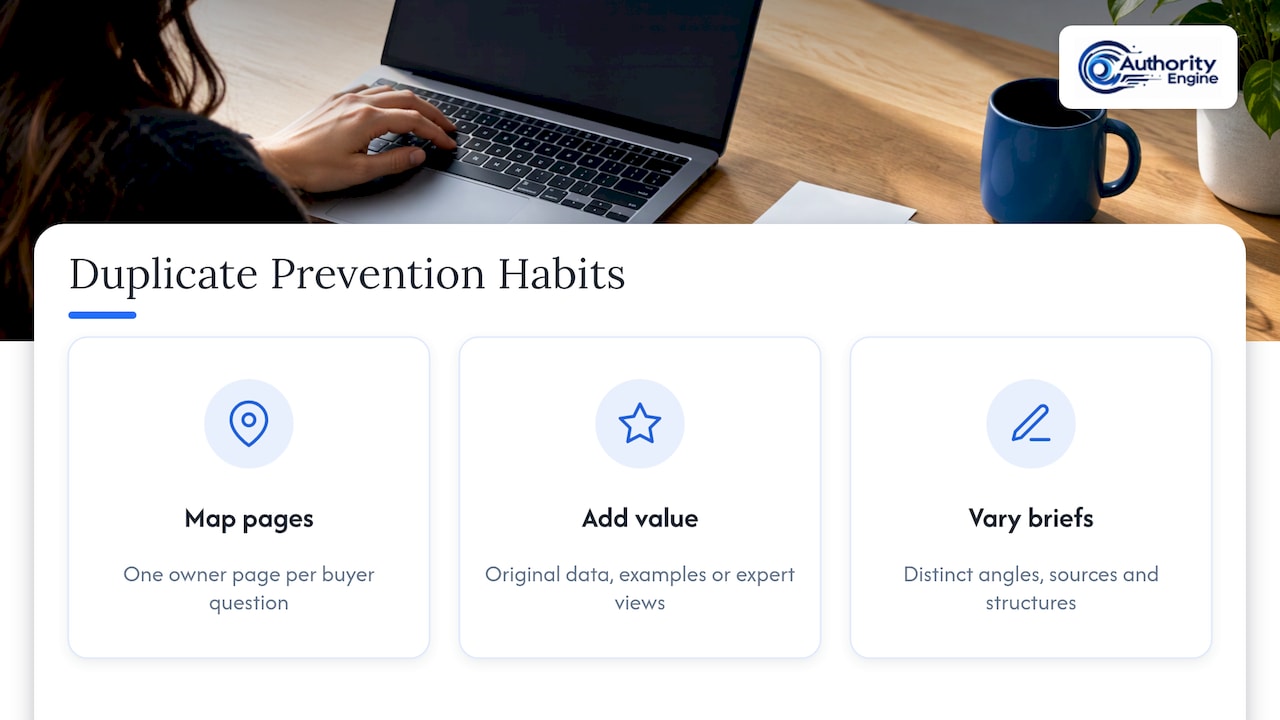
Pruning without a content rule only resets the clock. Three habits keep the site clean.
First, keep a content map with one owner page per buyer question. Before anyone writes a new article, they check the map. If a page already answers the question, the work is an update.
Second, make every page add something. Original data, a specific example from your own customers, a named expert’s view or a clear comparison give an AI system a reason to choose your page over a generic one. Our guides on writing for generative answers and on the checks before ChatGPT can cite you go deeper on this.
Third, vary how AI drafts are briefed. If your team uses AI assistance, give each piece a distinct angle, source material and structure, and have a subject-matter expert shape the final version. Identical prompts produce identical skeletons, and search engines notice repetitive phrasing and predictable conclusions.
Measuring whether pruning worked
Page count is not the outcome. Track whether buyers meet you more often and more accurately:
- Index health. Fewer URLs flagged as duplicates in Search Console, and Google’s chosen canonical matching yours.
- Right page, right query. For your priority buyer questions, the page that ranks or gets cited is the one you designated.
- AI referrals. Visits from ChatGPT, Perplexity and Google’s AI features, and how many different tools send them to the same page.
- Accuracy of answers. Ask the major assistants the questions buyers ask and read how your company is described. Outdated claims point to an old page still in circulation.
- Time. Google notes some effects of removing content take months, so judge over a quarter or more, not a week.
This monitoring loop is part of what our managed service covers: visibility monitoring and continuous refinement, so a consolidation is checked against what buyers actually see.
What we think about duplicate content
Most companies come to us thinking the problem is that they lack content. Often the problem is that they have too many pages saying nearly the same thing, and buyers using AI to research providers meet the weakest version.
Consolidation is a strategic decision, not a cleanup chore. Which page represents you on a buyer’s question? What does that page need to say to be trusted and considered? Who else vouches for you outside your own site? Those questions are commercial, and they are why we combine commercial strategy and doctoral research with SEO and answer engine optimization content, external authority-building and measurement.
A clean site is the foundation, but it is not the finish. Once there is one strong page per buyer question, contextual backlinks, community participation and executive LinkedIn content give AI systems the outside signals that say your company is a credible answer. We manage that work as an ongoing program, and our monthly site-health recommendations give your team a clear list of improvements to implement.
Dr. Patrick McAvoy
Getting a managed view of your own overlap
If your site has grown over years of blogs, service pages and AI-assisted drafts, the hard part is not knowing that duplicates exist. It is deciding which pages should represent you in front of buyers and then building the authority around them.

Our Managed AI Visibility service covers buyer-question and semantic research, strategic content creation and publishing, contextual backlinks, community participation, executive LinkedIn content, visibility monitoring and monthly site-health recommendations. To see where you stand first, request the AI Visibility & Revenue Opportunity Report. For the wider picture of how AI systems pick sources, read our guide to AI discoverability for marketers.
FAQ
Does Google penalize AI-generated duplicate content?
Google does not penalize content for being made with AI, and for ordinary duplicates it usually filters to one version instead of applying a penalty. Pages produced in bulk mainly to rank can fall under its scaled content abuse policy, however they were written. The safer path is one distinct, useful page per buyer question.
Is duplicate content the same as keyword cannibalization?
They overlap but are not the same. Duplicate content means pages that match or nearly match. Cannibalization means several pages target the same query and compete with each other, even if the wording differs. Both are fixed by deciding which page owns the topic and merging or redirecting the others.
Should I delete old pages to prune for AI search?
Deletion is the last option, for pages with no value and no equivalent. Pages that overlap should be merged into the strongest one with a 301 redirect, and pages with strong backlinks should redirect to the closest relevant page. Pages needed for policy or disclosure can be set to noindex.
How long do redirects need to stay in place?
Google’s guidance, as summarized by content audit practitioners, is to keep redirects for at least a year and avoid long chains. Aim for a single hop from the old URL to the final page.
Sources
- Deftly dealing with duplicate content, Google Search Central blog
- Is using AI-generated content for SEO plagiarism? Search Engine Land
- Does Duplicate Content Hurt SEO and AI Search Visibility? Bing Webmaster Blog
- Google’s guide to optimizing for generative AI features
- Google spam policies, scaled content abuse
- Duplicate content and SEO: The complete guide, Search Engine Land
- Content pruning for AI SEO, Search Engine Land
- How to specify a canonical, Google Search Central
- Google updates rel=canonical documentation, Search Engine Journal
- Duplicate content on product pages: quick fixes
- A 20-point technical SEO checklist for 2026