I first felt the shift in late 2023.
Our SEO wins looked perfect on paper: top-3 rankings, healthy click-through rates, strong engagement metrics. But sales kept telling me the same thing: prospects were showing up to calls with opinions already formed by AI summaries they’d read somewhere else.
Not by our content.
Around the same time, I started hearing a pattern in buyer interviews: “I asked ChatGPT who the best options were, then used Google to double-check a few things.”
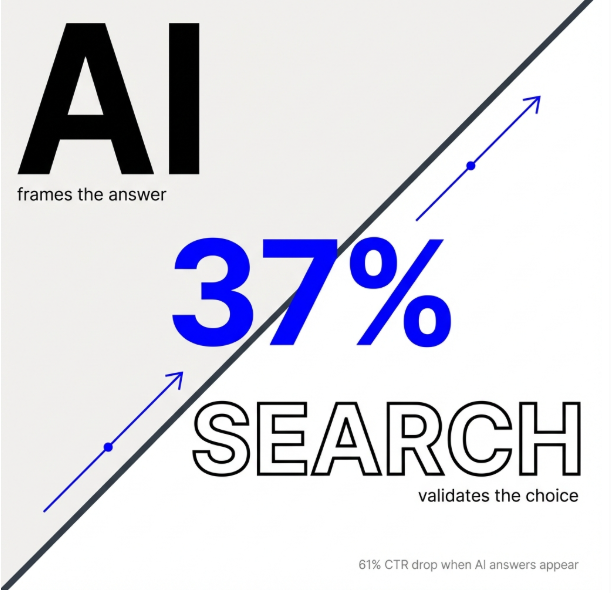
That’s when I realized the buyer journey had quietly split into two steps: AI to frame the answer and set the shortlist; search to validate.
You could win SEO and still lose the deal if you weren’t present in the AI layer.
The Traffic Shift Is Already Here
This isn’t a future trend. 37% of consumers now start their searches with AI tools instead of traditional search engines.
Nearly half say AI influences which brands they trust.
When AI Overviews appear, organic click-through rates drop 61%. Paid clicks crash 68%.
But here’s what matters: brands cited in those AI answers earn 35% more organic clicks and 91% more paid clicks than brands that aren’t mentioned.
The platforms aren’t waiting for you to figure this out. They’re already building someone else’s moat.
What AI Platforms Tell Buyers About You
AI assistants do three things your perfectly optimized content can’t counter on its own.
They narrow options to a small set of “safe” brands based on what they can verify across the web: third-party mentions, reviews, and comparison coverage. Even if you outrank competitors in Google, the AI summary leans on vendors with more PR and user-generated content.
They normalize you. Instead of emphasizing what makes you different, they group vendors into generic categories with typical pros and cons. Prospects show up saying, “You all basically do the same thing, so we’re comparing on price.”
They narrate the buying decision in ways that pre-frame objections. AI guidance now walks buyers through “how to choose a vendor,” emphasizing risk mitigation and social proof. That means buyers favor vendors with case studies, analyst coverage, and enterprise logos—signals that algorithms see easily.
By the time buyers reach you, they’re not asking if you’re the best fit. They’re asking if you can prove you’re as de-risked as the three names the AI already told them to trust.
What’s Missing From Your Digital Presence
Most companies build websites that convince humans, not ecosystems that prove credibility to machines.
What’s missing is an explicit, machine-readable case for “this brand is the safest, clearest answer on this topic.”
Explicit trust signals matter more than buried proof. AI tools lean on visible, verifiable cues: certifications, awards, reviews, analyst mentions, recognizable customers. Most brands tuck these into PDFs or scattered blog posts instead of structured, crawlable pages.
Structured authority beats “good content” every time. AI needs to understand who you are, what you’re authoritative on, and how your content connects. Many sites have solid articles but weak information architecture (unclear topical hubs, thin schema, inconsistent naming).
Brands winning in AI search deliberately map topics, use schema markup, and build clear hub-and-spoke content so engines can confidently pull and stitch answers.
Long-tail coverage that matches real prompts fills the gaps. AI answers trigger on specific, conversational questions (exactly where most brands have no targeted content). Leaders create pages that mirror how users actually ask for help: integrations, use cases, workflows, comparisons.
Consistent identity across the web builds trust. AI models cross-check your story everywhere you appear. Inconsistency weakens their confidence. Brands that show up as the “trusted answer” have synchronized messaging, current profiles, and aligned descriptions across every platform.
Designed-for-AI narratives make extraction easy. AI needs clean, declarative language it can safely quote. Most sites use vague marketing speak instead of crisp, supportable claims like “trusted by 2,000+ finance teams” or “SOC 2 Type II certified since 2022.”
The shift is this: stop asking “How do we rank a page?” and start asking “How do we make our expertise so structured and verifiable that an AI system would bet its reputation on us?”
What Happens to Your SEO Without AEO
Your SEO work doesn’t disappear. It gets demoted from “front door” to “unpaid R&D” for someone else’s answer layer.
Your pages become fuel, not destinations. When AI overviews sit above results, the top organic listing can lose up to half its clicks while still being used as a source. Your content trains the models, but users stay in the AI interface.
Metrics stay “good” while the pipeline erodes. Impressions and average position look stable, while clicks and conversions quietly drop because AI answers satisfy the query first. SEO dashboards say “we’re winning” while revenue metrics say “we’re leaking.”
AI rewrites your positioning for you. If you haven’t structured your proof and differentiation for machines, models default to patterns they recognize across your category. You show up as a generic example rather than the recommended choice.
Competitors with AEO steal the “first mention.” Brands optimizing for AI tune schema, topical clusters, and trust signals to increase their citation rate (even when they don’t own every traditional ranking). Your SEO holds positions, but the first brand name buyers hear from AI is a competitor.
SEO without AEO becomes table stakes: necessary for being indexed, insufficient for being chosen.
Why GEO Traffic Converts Differently
AEO makes you legible to machines. GEO engineers where, when, and how those machines use you in their answers.
GEO focuses on earning citations and links from AI assistants across the specific questions your buyers ask.
The conversion difference is dramatic. Brands executing strategic GEO see 6X to 27X higher conversion rates compared to traditional search traffic. At Ahrefs, AI search visitors convert at a 23X higher rate than organic visitors.
Traditional SEO captures people at varying intent levels. Some browse, some benchmark, a few are ready to act. You do the heavy lifting of qualification on your site.
GEO traffic arrives after the AI has already narrowed the field, framed your strengths, and answered basic objections. Those visitors hit your site with a clearer problem, shorter shortlist, and higher purchase intent.
Without AEO, GEO doesn’t stick. You might get experimental mentions, but the model has no consistent data backbone to trust you repeatedly.
With AEO in place, GEO gives you leverage on past SEO work. You re-architect content, entities, and signals so the same assets that used to win “10 blue links” now win the first answer, first mention, and first click in AI-led journeys.
The Window Is Narrowing
AI-sourced traffic has grown several hundred percent year over year. Daily AI use has doubled in months.
Early movers are locking in trust relationships. Generative engines develop preferences for sources that consistently provide accurate, structured information. Case studies show brands that implemented AEO frameworks early see content discovered up to 10X faster by AI engines.
The cost of waiting is cumulative. If you delay six months, you’re giving competitors time to train AI systems that their version of your category is the default.
Displacing an entrenched source later is harder and more expensive than becoming that source now.
As AI becomes the first touchpoint, your existing SEO increasingly feeds zero-click answers rather than owned sessions. Building AEO now lets you repurpose that SEO footprint into AI-visible authority while it still has momentum.
The Mental Shift That Changes Everything
Stop thinking “SEO and GEO are channels.”
Start thinking “AI search is the new front door, and my job is to be the brand it trusts enough to recommend first.”
Most buyers will meet you inside an AI summary, where answers are compared, ranked, and narrated before any click.
SEO becomes the groundwork. GEO becomes amplification. AEO is the shared operating system underneath everything you ship.
When you see it that way, the question isn’t whether to build AEO infrastructure.
The question is whether you want to be the brand AI defaults to, or the one that shows up as a footnote, if at all.