
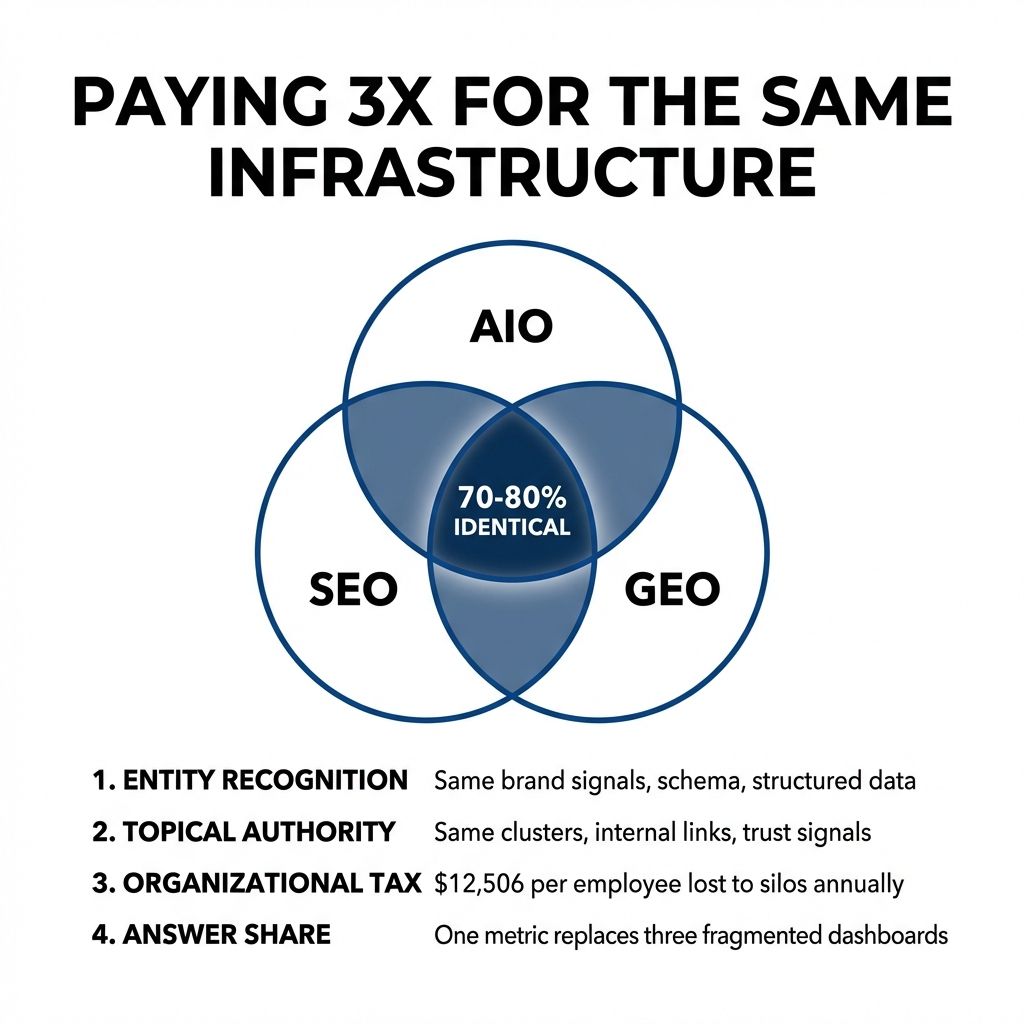
Most B2B companies with established SEO programs are now being told they need separate GEO and AIO strategies.
The pitch sounds reasonable: AI engines work differently than traditional search, so you need different optimization approaches. ChatGPT processes over 2 billion queries daily, and 65% of Google searches end without a click. You need to be visible where your buyers are looking.
But here’s what the agencies selling you three separate retainers won’t tell you: you’re paying to rebuild the same infrastructure three times.
The Fragmentation Problem Nobody’s Naming
I’ve watched companies spin up “GEO blogs” and “AI clusters” as extra content calendars, sitting beside their existing SEO library. They brief each program separately, track different KPIs, and report to different stakeholders.
The result is duplication, cannibalization, and a mess of overlapping pages that confuse both traditional search and generative systems about which URL should be the canonical answer.
According to McKinsey’s 2026 Global Merchant Survey, merchants spend 40% of their time on low-value activities and reconciling data across siloed systems. For B2B organizations, this fragmentation shows up as three teams optimizing the same entities, implementing overlapping schema, and building competing topic clusters.
The market is now flooded with traditional SEO agencies that have simply added “AEO” or “GEO” to their services page without having the underlying technical capabilities or methodological depth to deliver results.
What the Acronyms Hide: 70-80% Identical Infrastructure
When you map the technical requirements of SEO, GEO, and AIO, they’re semantically identical at the infrastructure level.
All three require:
Entity recognition. A solid SEO setup already cares about consistent brand information, clear about pages, and structured details. This is exactly what LLMs use as entity signals. Entity clarity now determines whether your content is recognized as the right answer in AI Overviews and semantic search.
Topical authority. Topic clusters, hubs, and internal link graphs for authority are the same mechanics GEO uses to prove you’re the canonical answer on a subject. Sites with comprehensive entity coverage were far more likely to rank in the top three positions, and 88% of SEO professionals consider topical authority critical for ranking success.
Structured data. The same schema implementation—Organization, Product, FAQ, HowTo schema—serves both traditional search and AI answer engines. Google reports that pages enhanced with structured data saw a 25% higher click-through rate compared to pages without it. This same markup is what LLMs use to extract and cite content.
Trust signals. Human expertise, references, brand mentions, and clean technical health are long-standing ranking factors and now double as “can I safely cite this?” signals for AI systems.
The differences are mostly in who you’re optimizing for and how directly you make your content usable by machines. SEO’s win is a click to your page. GEO’s win is being the sentence, stat, or framework that shows up inside the AI response. Same system, different distribution layer.
The Organizational Tax You’re Actually Paying
The real cost of fragmentation isn’t just inefficiency. It’s structural disadvantage.
Miscommunication costs businesses an average of $12,506 per employee every year. For a mid-sized company with 200 employees, that’s $2.5 million slipping through the cracks annually.
Companies with inadequate marketing-sales alignment lose an average of 10-15% of their potential revenue. This figure climbs to 15-20% when multiple silo symptoms are present. The same dynamic occurs when SEO, GEO, and AIO teams operate independently.
Here’s what that looks like in practice:
You’re paying three strategy taxes. Each program has its own research, briefs, and production overhead on similar topics. You’re not reusing insights across consumption modes. You’re rebuilding them with slightly different wrappers.
Your authority signals are splitting. Near-duplicate intents scattered across URLs and initiatives split authority. Search and AI systems have to choose between versions, so links, clicks, mentions, and engagement get spread thinly across multiple pages instead of concentrating on one canonical asset.
Your internal links are fighting each other. Siloed programs misalign internal links. SEO wants one path, AIO another, GEO a third. This weakens the site’s own distribution and confuses algorithms about topical boundaries.
Your crawl budget is bloated. Running three partially redundant programs bloats the index with near-duplicates and confuses both search engines and LLMs. For AI systems, fewer but stronger, better-structured entities and pages make it easier to select you as the canonical source for a topic.
Why Vendors Sell It This Way
From the vendor side, carving one discipline into three programs is commercially convenient.
New acronym equals new SKU. “SEO,” “GEO,” and “AIO” give agencies separate retainers, roadmaps, and case studies, even though the core tactics materially overlap. It’s easier to sell “a GEO pilot” or “an AIO add-on” to a CMO who already has SEO in place than to say your entire information infrastructure has to change.
But this plugs directly into how buyers are organized.
Most companies are literally wired to purchase channels, not systems. Budget lines are channel-specific: “SEO/organic,” “Paid search,” “Brand,” “Innovation/AI.” It’s structurally easier to approve an “AIO initiative” under an AI/innovation bucket than to re-platform SEO across functions.
Teams are siloed by output: SEO under growth, content under brand, “AI” or “labs” under strategy/innovation. Each gets its own KPIs and its own vendors, so they default to buying discrete programs that map to their swim lane.
You end up with three projects because the org chart wants three projects.
The Compounding Effects of Consolidation
When you stop fragmenting the work, every improvement you make to the infrastructure throws off more ranking, more AI visibility, and more revenue per change.
Authority signals start stacking. When you consolidate, every new link, brand mention, and engagement signal flows into the same pillar or cluster instead of competing siblings. This drives much faster ranking and trust acceleration across that topic.
Topic clusters become true flywheels. Unified governance lets you build real pillar-cluster structures, where each new piece reinforces the rest instead of competing with it. As clusters mature, new pages in that topic start ranking disproportionately fast because algorithms already trust you on that subject.
Each refresh delivers outsized gains. A unified system lets you treat refreshes as compounding events. Each update revalidates an already-trusted page, triggers re-evaluation with more accumulated authority, and often yields ranking jumps disproportionate to the effort.
Marginal content cost drops. You reuse research, briefs, and assets across all consumption modes: one pillar, one set of FAQs, one schema implementation, rather than rebuilding them with slightly different wrappers. Savings can then be reinvested into depth instead of breadth of mediocre pieces.
Topic-clustered, non-duplicated sites see materially faster ranking and traffic growth than scattered ones, with some reporting 40-130% organic lifts after adopting unified cluster models.
Answer Share: The Unifying Metric
The real breakthrough is recognizing that SEO, GEO, and AIO all collapse into one question: What percentage of category questions are answered by our infrastructure, whether on Google, AI chat, or our own properties?
Traditional metrics like traffic, impressions, and keyword rankings are lagging indicators at best in the AEO era. Success in 2026 won’t be defined solely by organic traffic or rankings. It will hinge on how effectively a brand appears inside AI answers, AI Overviews, and LLM-powered recommendations.
Deloitte.com and McKinsey.com lead in B2B AI citations because they are considered authorities for B2B queries, producing extensive thought leadership, white papers, and industry analysis that AI models rely on to answer complex questions. They dominate through a unified authority infrastructure.
Once you adopt answer share as a north star, it becomes obvious you can’t afford three disconnected programs trying to influence the same model. You need one system that maximizes your share of answers everywhere.
The Competitive Risk of Staying Fragmented
While you’re running three separate programs, your competitors who consolidate into a unified authority infrastructure are becoming the “obvious answer” everywhere.
They lose the default answer position. Unified systems make it trivial for algorithms and LLMs to see who owns a topic. Fragmented setups make that answer fuzzy. Your split signals make you look like three half-serious contenders.
Their growth compounds while yours stays linear. Consolidated clusters mean each new piece accelerates the next. Fragmented ones mean each new piece competes with the last. As competitors stack authority in clean clusters, they hit the flywheel phase: faster rankings, broader long-tail coverage, while your returns per new page shrink.
They lower CAC while yours quietly rises. When infrastructure is unified, acquisition efficiency improves steadily. Competitors’ marginal cost per incremental organic or AI-driven visit drops as their authority and reuse increase. You keep paying three strategy taxes on overlapping work, so true blended CAC creeps up even if each channel’s report looks fine in isolation.
They become more algorithm-resilient. Clean clusters, reduced duplication, and strong entity clarity make competitors less sensitive to which exact ranking or answer-engine pattern is in play. Your stack of half-overlapping assets and conflicting signals is more likely to be down-weighted when an update or model retrain happens.
They own a coherent narrative. A consolidated entity and content model yields consistent claims, pricing, positioning, and examples across search, AI answers, and your own site. Fragmentation means different teams and vendors are subtly rewriting facts and narratives per program, increasing the odds of inconsistencies and AI hallucinations about you.
The brands visible today are training the retrieval patterns of tomorrow. Companies that own an answer share now will compound that advantage as AI models reinforce their authority through repeated citations.
The Practical Transition Path
If you’ve been running separate SEO, GEO, and AIO programs, you can collapse them into one unified system without losing momentum.
Create one owner. Appoint a single Information Infrastructure owner responsible for entities, content standards, schema, and internal linking, regardless of channel label. Freeze existing SEO/GEO/AIO scopes for 30-60 days. No program is shut off, but all net-new work must route through this owner for prioritization.
Merge the roadmaps. Take all in-flight and planned work and rewrite them as asset-level tickets. Tag each ticket with the consumption modes it serves (SEO, GEO, AIO), but treat it as one piece of work that one team delivers.
Re-scope the agencies. Pick one primary infrastructure partner to own core work: topic and cluster strategy, entity mapping, schema, content production and refresh, internal links. Shift others to clearly bounded, additive roles like analytics, PR, or AI-monitoring only.
Replace three dashboards with one source of truth. Stand up a unified reporting layer that tracks, per asset and cluster, organic search performance, AI and answer-engine mentions, and downstream conversions. Build three views off that same dataset, so each stakeholder still sees their metrics.
Protect high-value assets. Flag top-performing URLs as protected assets. Any change must be proposed as a single combined ticket and shipped by the infrastructure owner. Require reversible, incremental changes with monitoring periods.
Transition AI-specific work into governance. Spin out a small AI visibility and governance stream for monitoring AI answers, tracking brand and entity mentions, auditing hallucinations, and running prompt-level experiments. This team creates requirements for the infrastructure team, not a parallel roadmap.
By day 90, you’re doing the same or more throughput with fewer hands touching each asset.
The Real Strategic Choice
The question facing B2B organizations is whether you want to be the company that algorithms and LLMs trust by default in your category.
The only reliable way to win that game is to own one unified authority infrastructure.
Five years out, companies that consolidate will have a durable, compounding authority machine. Companies that keep buying separate SEO, GEO, and AIO programs will have a trail of case studies and no real structural advantage.
The companies that win in 2026 won’t be the ones still arguing about whether GEO matters or debating if SEO is dead. They’ll be the ones who committed to a dual-optimization strategy that influences buyers wherever they’re searching.
Authority infrastructure protects, amplifies, and compounds the value of the traffic you already earn. In an AI-influenced environment, credibility becomes compounding infrastructure. The clearer your authority signals, the more durable your visibility.
Everyone else spends the rest of the decade renting attention from platforms while their better-organized competitors quietly become the substrate those platforms depend on.
References
-
WhiteHat SEO. “From SEO to AIO: Understanding AI Optimization.” https://whitehat-seo.co.uk/blog/from-seo-to-aio
-
Monday.com. “Marketing Silos: McKinsey’s 2026 Global Merchant Survey.” https://monday.com/blog/marketing/marketing-silos/
-
AB Marketing Agency. “2026 Top 5 B2B AEO and GEO Agencies for Large and Enterprise SaaS Organizations.” https://abmagency.com/2026-top-5-b2b-aeo-and-geo-agencies-for-large-and-enterprise-saas-organizations/
-
Search Engine Land. “Entity-First Content Optimization Guide.” https://searchengineland.com/guide/entity-first-content-optimization
-
Content Whale. “Boost Business Topical Authority with Entity SEO.” https://content-whale.com/us/blog/boost-business-topical-authority-with-entity-seo/
-
Pebb. “The Cost of Communication Silos and How to Break Them.” https://pebb.io/articles/the-cost-of-communication-silos-and-how-to-break-them
-
Khilon. “Marketing Silos Are Costing You Money: The Hidden Truth 2025 Guide.” https://khilon.com/marketing-silos-are-costing-you-money-the-hidden-truth-2025-guide/
-
Averi. “Topic Clusters for SaaS: 40-130% Organic Lifts.” https://averi.ai/how-to/topic-clusters-for-saas
-
Conductor. “AEO & GEO Benchmarks Report.” https://www.conductor.com/academy/aeo-geo-benchmarks-report/
-
Stupid Dope. “AI Search Optimization: New SEO Arms Race 2026.” https://stupiddope.com/2026/02/ai-search-optimization-new-seo-arms-race-2026/
-
Firebrand Marketing. “GEO and SEO Predictions 2026.” https://www.firebrand.marketing/2025/12/geo-and-seo-predictions-2026/