
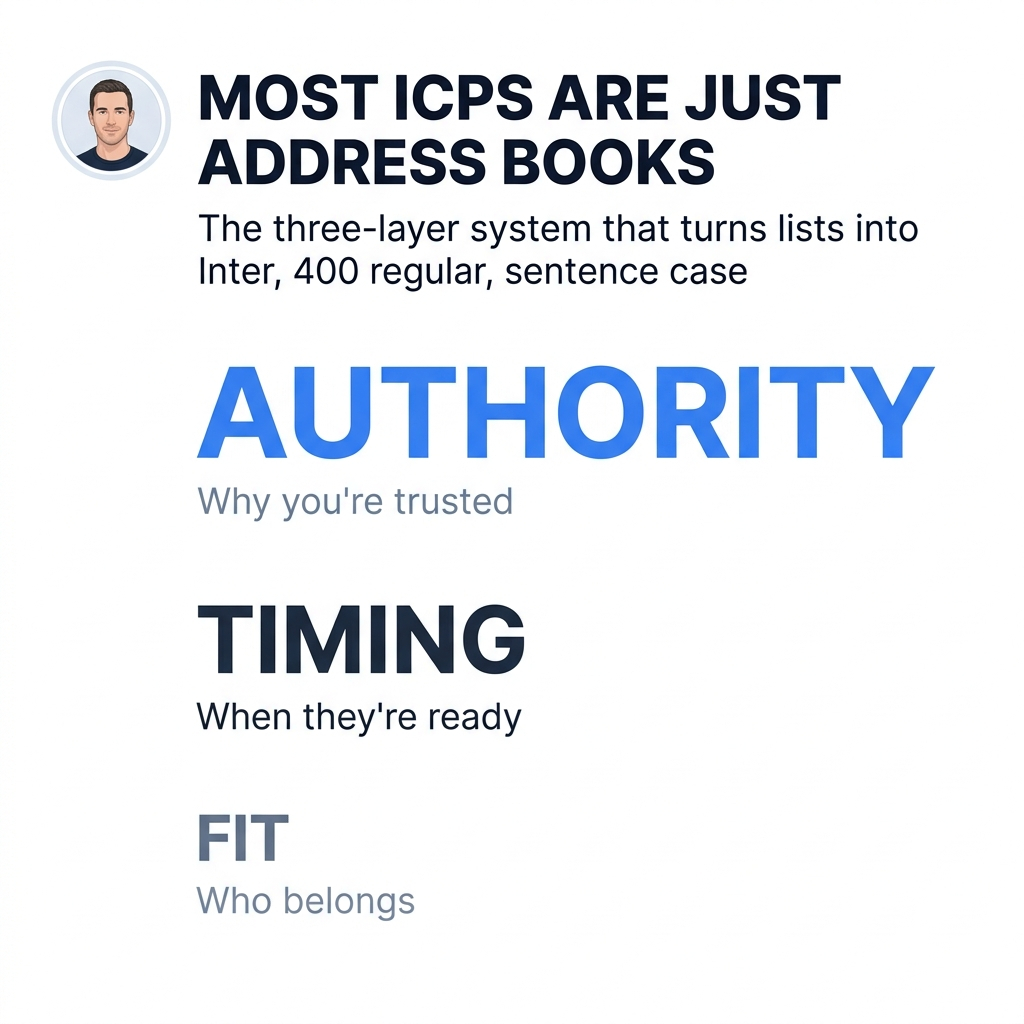
Most B2B teams treat ICP development as a one-time exercise. You define firmographics, maybe add a persona or two, then hand it off to sales and marketing.
The result? Reply rates stuck at 2-3%, long sales cycles, and accounts that look perfect on paper but never convert.
I’ve watched this pattern repeat across dozens of companies. They have the right accounts, decent messaging, and solid products. But they’re missing the layer that turns a static list into a revenue system.
Authority Engine’s ICP methodology fixes this by layering three elements: fit, timing, and authority.
This article breaks down exactly how the system works, how we prioritize which accounts to target when, and how authority infrastructure makes you the trusted answer when buyers are ready.
Why Traditional ICP Development Fails in 2026
The industry built ICP around firmographics because that’s all we had. For years, the only scalable data was industry codes, employee counts, and revenue ranges.
Leadership needed stable definitions for territory planning and quota setting. Marketing needed big lists to hit volume targets. So ICP became a static profile that changed once a year, if at all.
Three assumptions locked this approach in place:
Past closes define future best-fit. Teams averaged the firmographics of closed-won customers and assumed those patterns would stay stable. Markets evolve faster than annual ICP reviews.
Same firmographics mean same urgency. Two companies with identical size, industry, and tech stack got treated as equally promising. One is in acute pain. The other is coasting. Your outreach hits both the same way.
Timing is a sales problem, not a definition problem. ICP was a marketing artifact. Sales had to figure out when buyers were ready. The definition itself never encoded pressure or intent.
That worked when data was coarse and distribution was expensive. It breaks in a signal-rich, AI-mediated market where companies with well-defined ICPs achieve faster sales cycles and higher conversion rates.
The Three-Layer System: Fit, Timing, and Authority
Authority Engine’s approach treats ICP as a living system with three required layers.
Layer 1: Fit (Who Belongs in Your Universe)
Fit is your firmographic boundary. Industry, size, tech stack, geography. This hasn’t changed much, and it shouldn’t.
We keep your existing ICP as the starting hypothesis. No need to rewrite the deck or restructure territories. Fit defines who you care about.
But fit alone is just an address book.
Layer 2: Timing (When They Feel Real Pressure)
Timing separates the 10-20% of your ICP that’s visibly in motion right now from the 80-90% that’s not.
We layer intent signals onto your fit criteria:
Research behavior: Multiple visits to buyer-stage pages like pricing, comparisons, or implementation guides. Long sessions. Returns over several days. Intent-based marketing unlocks dynamic personalization based on real-time behavior.
Tech and hiring changes: Adopting complementary tools, replacing adjacent systems, or hiring roles tied to your category. These signal structural preparation before explicit search spikes.
Trigger events: Funding rounds, leadership changes, compliance deadlines, vendor migrations. Trigger-based approaches yield 4x higher conversions and 30% shorter sales cycles.
We pull this from first-party analytics, third-party intent networks, and technographic datasets. Then we score accounts by intent strength and stage.
Early research looks different from decision-stage comparison. Your messaging and proof need to match where they are.
Layer 3: Authority (Why You’re the Safest Answer)
Even with perfect timing, most brands don’t have the infrastructure to be the trusted answer.
Authority infrastructure is the system that makes you machine-trustable and human-credible around specific problems in your category.
We build:
Verified entity core: Clean, aligned brand and product data across your site, knowledge panels, directories, and key platforms. AI systems need to confidently recognize you’re the same real company everywhere.
Proof-dense, structured answers: Canonical answer hubs for priority questions, marked up with schema and citations. External validation tied back to specific problems and solutions.
Answer-ready outreach assets: Email, social, and sales content written as compressed, question-specific answers. Not generic pitches.
When a high-intent account researches your category, they encounter a tightly aligned answer universe. AI platforms see coherent data and structured proof. Humans see reinforcing validation at every turn.
You become the de-risked choice.
How We Decide Which Questions Deserve Infrastructure Investment
You can’t build authority around every question. We prioritize using a filter that sits at the intersection of three criteria.
High Buyer Pressure
We map the actual pressure moments your ICP experiences, then express those as questions.
Acute, non-optional problems force action. Something is breaking, costs are spiking, leadership is pushing. We look for repeated patterns in calls, win/loss notes, support tickets, and intent data.
If a question doesn’t show up in those pressure moments, we don’t build infrastructure around it.
High Revenue Leverage
From that list, we keep only questions that directly change pipeline or ACV when answered well.
Does this question reliably mark, accelerate, or unblock a revenue stage? Is it asked often enough, in deals large enough, that moving the win rate even slightly has meaningful impact?
If answering it brilliantly wouldn’t noticeably move reply rates, deal velocity, or win rates, it doesn’t get authority infrastructure.
High Winnability
We check whether you have a realistic path to becoming the trusted answer.
Do you have real stories, data, or a distinctive approach that make your answer meaningfully better than generic market noise? Does this question align with how you should be known in the market, or does it dilute your core category story?
If you don’t have a strong, provable point of view, we either reshape the question or deprioritize it until proof and positioning catch up.
Validation Through Live Signals
We overlay timing and intent data to validate the question portfolio.
Do we consistently see this question’s topics in search behavior, page paths, third-party intent, and sales conversations across your best-fit accounts? Does it line up with observable triggers so we can reliably know when to activate the infrastructure?
Questions that look important in theory but don’t show up in live signals get pushed down the roadmap.
The Sequencing Logic: Proof Fast, Then Infrastructure Where Proof Agrees
Most companies can’t flip a switch and suddenly have fit, timing, and authority working together. We sequence it so you get proof fast while the deeper work spins up.
Phase 1: Keep Your ICP, Add Right-Now Signals
We don’t rewrite your ICP deck. We treat it as a fit hypothesis and immediately overlay timing.
Use your current firmographic ICP as the boundary. Plug in available signals to find the 10-20% of that ICP that’s visibly in motion right now.
This gives you a quick shift from big static list to live short list with minimal change management. Early reply and meeting lifts are attributable and easy to see.
Phase 2: Prove It With Campaigns
We route those high-intent ICP accounts into tightly scoped campaigns whose job is to pay for the authority work.
Launch focused outbound and AI-driven campaigns to that narrowed segment. Sharper, question-based messaging but before heavy infrastructure changes.
Measure short-cycle proof: reply rate, meeting rate, early pipeline, and where deals stall. This is the 90-day proof loop. Performance campaigns give executives immediate, measurable upside while we learn which questions and segments are most responsive.
Phase 3: Concentrate Authority Where Signals and Revenue Agree
Only once we see where reality is pulling do we invest in full authority infrastructure.
Pick a narrow set of questions and segments where Phase 2 campaigns clearly outperformed. Build the structured answer universe there: entity cleanup, schema on key pages, proof-dense hubs, third-party validation, and consistent messaging mapped to those specific questions.
Now your best-performing lanes get cheaper and faster. AI systems can see and trust you. Humans encounter reinforcing proof. The same campaigns convert better without more spend.
Phase 4: Feed the Loop Back Into ICP and Scale
We update how you define and use ICP based on what the system has learned.
Refine ICP definitions to encode not just firmographics but the patterns of pressure and proof that actually drive revenue. Replicate the authority plus intent pattern into adjacent questions and segments, always starting with signal-backed, revenue-proven lanes first.
The unlock order is: keep your ICP, layer intent and run targeted campaigns, see where reality responds, build authority infrastructure there, then let that new reality reshape your ICP.
The Organizational Structure That Makes This Work
For fit, timing, and authority to actually work, someone has to own it as one revenue system.
Usually that’s a RevOps or head of revenue engine function with explicit authority across marketing, sales, and data. Around that owner, you want a stable pod: marketing for authority and content, sales leadership for outreach and ICP, and ops for signals, routing, and reporting.
All accountable to shared revenue metrics, not separate dashboards.
How Handoffs Work When It’s Healthy
Data and signals (ops/RevOps): Maintain the single source of truth. Implement fit plus intent plus recency plus engagement scoring. Automatically surface Tier 1 right-now accounts to marketing and sales.
Authority and messaging (marketing): Own the question portfolio and authority infrastructure. Provide playbooks and assets aligned to each score and state. Tier 1, comparison-stage gets specific narratives and proof.
Activation and feedback (sales): Work only the prioritized accounts. Follow the intent-aware plays. Feed back what’s actually happening so scoring and questions get refined.
In practice: signals update, accounts move tiers automatically, specific plays and assets are triggered, sales executes, weekly review closes the loop.
The Friction That Usually Kills It
The number one execution killer is misaligned definitions and incentives.
Marketing, sales, and ops work off different data and definitions of good account or qualified. Nobody trusts the scores or the signals.
Marketing is rewarded for volume and sourced pipeline. Sales for closed revenue. Ops for system stability. So intent and authority get treated as extra work, not the default way to hit their number.
When that happens, fit, timing, and authority slide back into silos. Ops hoards dashboards. Marketing runs content campaigns no one uses. Sales ignores the scores and goes back to brute-force outbound.
The strategy dies in the gap between teams, not in the deck.
What This Looks Like in Practice
One client went from great ICP, weak response to a 3-4x lift in demos and revenue once we stopped targeting by fit alone.
Before, they had a polished ICP, an intent provider, a content calendar, and a RevOps hire. Reply rates were stuck around low single digits. Sales complained the leads were the same noise in a different dashboard.
We asked for a narrow lane and 90 days.
We kept their ICP but took the top few hundred accounts and overlaid just a couple of high-precision signals. Real research plus real trigger events instead of broad, fuzzy topics.
Then we rebuilt only a few plays. Outreach and follow-up tied to specific questions those accounts were clearly wrestling with, pointing into a tighter proof story instead of generic assets.
Within weeks, they were looking at side-by-side numbers. Same reps, same product, same price.
Old way sequences running against generic ICP: low-single-digit replies, long messy cycles.
System sequences against fit plus timing plus authority: multiple times higher reply and meeting rates, plus a visible jump in opportunity conversion from those accounts.
The turning point wasn’t just the metrics. It was reps forwarding replies to leadership that literally said, “Funny timing—we’re in the middle of this exact project, can you talk this week?”
By the end of the engagement, the same COO who started out skeptical was policing old habits. They stopped approving campaigns that were ICP-correct but timing-blind. They redefined ICP internally as the accounts where we have both a right to win and a reason to be in their inbox this quarter.
Why Most Teams Have Good Data But Still Get Ignored
Having the signal doesn’t move the needle because most teams stop at who clicked what instead of turning that into a clear moment, narrative, and answer for that account.
Decontextualized signals: Teams dump high-intent accounts into generic outbound or ads without clarifying why that account is spiking, what stage they’re in, and what decision they’re wrestling with. The prospect experiences yet another cold pitch that happens to arrive after they clicked something.
Same data, same spam: Intent data is now widely available. Many vendors are hammering the same accounts off the same triggers. Overloaded buyers see 10 nearly identical “noticed you were researching X” messages and ignore all of them.
No authority or proof for the signal: Even when timing is right, most brands don’t have the authority infrastructure around the questions their ICP is asking. Inconsistent data and weak third-party validation mean AI search and humans don’t recognize you as a trusted entity in that topic.
No activation loop into messaging and ops: Teams park intent inside dashboards instead of wiring it into their actual motions. Slow manual handoffs. No playbook mapping this signal pattern to this narrative, offer, assets, and follow-up path. Reps default to whatever generic sequence they already had.
The lift happens when a signal automatically changes who is prioritized and what is said, with the right proof objects attached.
The One-Sentence Reframe
If you stop at who’s a fit and never engineer when they feel real pressure and why you’re the safest answer, your ICP is just an address book—not a revenue system.
That’s the shift Authority Engine makes real. We turn scattered data, content, and outreach into a unified system where fit, timing, and authority work together to make you the trusted answer in the moments that matter most.