
TL;DR: Traditional SEO optimizes for rankings and clicks, but AI answer engines reward depth, originality, and entity-level authority. The gap between traffic metrics and pipeline results reveals a fundamental mismatch: you’re optimizing for visibility in a system that now prioritizes being the cited, trusted source. Understanding this structural shift is the first step toward building systems that actually work.
Key Takeaways
-
73% of B2B websites lost traffic in 2024-2025, but the real problem is that organic programs showing traffic growth simultaneously failed to produce a pipeline.
-
AI-referred traffic converts at 23x the rate of traditional organic because these buyers arrive already educated about the solution.
-
Only 12% of URLs cited by AI tools appear in Google’s top 10 results, proving that ranking #1 no longer guarantees citation in AI responses.
-
Content with original research gets cited 3.5-4x more often than generic content because AI systems value unique information they can’t find elsewhere.
-
The 2-3-year competitive window through 2028 represents the transition phase in which serious AEO work creates a real advantage before it becomes table stakes.
When Did the System Actually Break?
I first saw it in the 2023-2024 data.
Organic programs that looked successful in Google Analytics were clearly failing to produce a pipeline. AI-first discovery channels made that gap impossible to ignore.
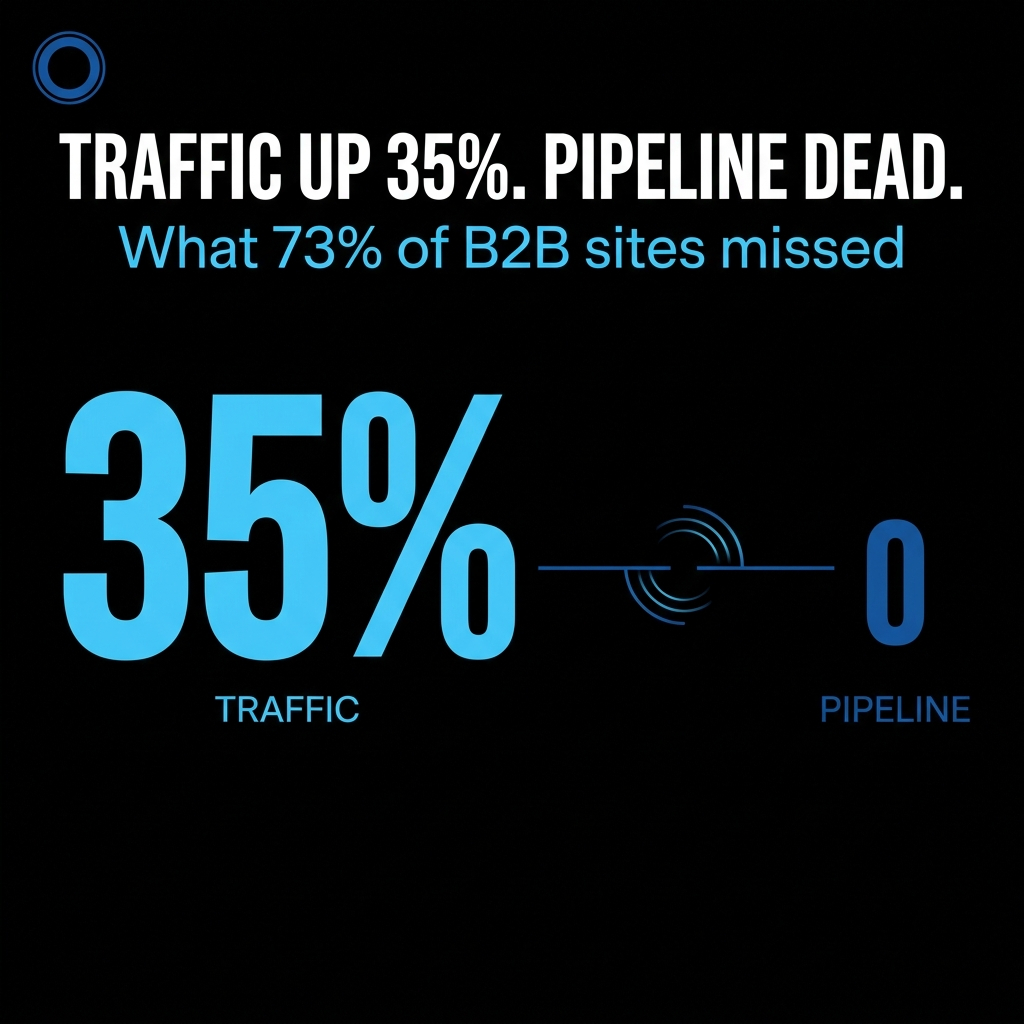
One B2B SaaS client’s organic sessions climbed 35% year-over-year, while sales-accepted opportunities from organic remained flat or declined. The SEO report looked like a promotional case. The pipeline report looked like a warning light.
That was the moment it became obvious that traditional SEO wasn’t just underperforming. It was optimizing for the wrong layer of the system entirely.
The decoupling was brutal and specific. Traffic graphs are trending up. Revenue from organic is stagnating or declining. More qualitative reports of buyers saying “I found you in an AI answer” or “I saw your brand referenced in a Reddit thread,” even when those sessions didn’t originate from classic search clicks.
The metrics traditional SEO was built to win stopped correlating with the outcomes we actually cared about: pipeline, revenue, and being referenced as the authority in AI-generated answers.
What Changed at the System Level?
Discovery itself shifted from “search and browse” to “prompt and synthesize.”
The system no longer rewards those who can drive the most clicks. It rewards those who can be trusted and cited as the underlying source when AI systems and humans stitch together an answer.
Traditional SEO was doing its job, maximizing blue-link visibility, but the job itself had changed. The real game moved down a layer.
Instead of asking “Are we ranking?,” the more important questions became “Are we being referenced?” and “Are we the entity the system associates with this problem?”
The data make this structural shift impossible to ignore. As of 2025, approximately 60-65% of searches end without a click to an external website. On mobile, that number jumps to over 75%.
Google’s AI Overviews now appear in 47% of searches, up from just 7% last year. The informational queries that once filled top-of-funnel pipelines are now answered instantly by AI engines.
This creates a massive attribution problem where the buyer journey fades into the “dark funnel” that traditional analytics struggle to track.
Why Schema and Entity Work Actually Matters Now
Most organizations have immature schema implementation and weak entity markup because these weren’t priorities under the old paradigm.
The good news is that fixing infrastructure creates compounding advantages over time.
Content with structured data earns 42% more citations. Pages with comprehensive schema markup receive 3.2 times as many answer engine citations for competitive topics as pages with basic or missing markup.
AI systems don’t just read your blog. They interpret your entire digital exhaust—product docs, support content, pricing, reviews, profiles, even inconsistent metadata—and build a probabilistic picture of who you are and what you’re good at.
Fragmented, contradictory data dilutes your signal and makes you a risky source for models. Clean entities, consistent naming, up-to-date documentation, and aligned descriptions across your site massively increase your odds of being cited.
This is as much a data and governance problem as it is a content problem. Brands that treat their digital presence as a coherent, governed knowledge base are the ones that consistently show up as trusted sources.
Where AI Systems Actually Learn to Trust You
Brand websites make up just 5-10% of the sources AI systems cite.
The real authority game plays out across Reddit, review sites, knowledge bases, and third-party platforms, where AI systems actually learn to trust you.
Reddit is the #1 source across every major AI engine, cited at roughly 40% frequency across LLMs. This is based on analysis of more than 680 million individual citations across ChatGPT, Google AI Overviews, Perplexity, Gemini, and Claude.
Community signals from Reddit and practitioner forums now feed AI systems. This means authentic expertise and helpful participation finally have measurable infrastructure value.
Research from Princeton found that adding expert quotes boosts AI visibility by roughly 41%, statistics by about 30%, and citations by around 30%. These aren’t abstract best practices. They’re quantified levers that move the citation needle.
AI systems weigh content based on authorship validation and entity consistency. Signals that reward genuine authority can be built systematically by organizations willing to invest in the right infrastructure.
How to Measure What Traditional Analytics Can’t See
Traditional SEO tracks keyword rankings in a search index.
AI citation tracking measures whether LLMs include your brand in dynamically generated answers—a signal that is ephemeral, query-dependent, and not directly visible in any public index.
This requires entirely different tools and measurement frameworks. In AI answer surfaces, position #1 no longer exists as it used to. You’re either in the answer, mentioned, or cited, or you’re not.
Marketers need a KPI stack that aligns with how search engines behave: visibility, sentiment, and citations, not rankings and clicks.
The “mention-citation gap” reveals a critical content failure. If you’re frequently mentioned but never cited, the AI knows who you are but doesn’t trust your content enough to use it as a source.
Citations are the currency of AI search. They validate your content as authoritative and are the primary mechanism for driving valuable referral traffic from an AI response back to your website.
But they also drive unmeasurable influence when buyers see a brand cited in an AI answer, then search for it directly or mention it in an internal Slack thread.
The Competitive Window Is Measured in Years, Not Quarters
Gartner predicts that traditional search volume will drop by 25% by 2026 as AI answer engines gain adoption and capability.
Over 400 million people use OpenAI products weekly. These platforms have become integral to information discovery faster than most marketing teams realized.
The window is measured in a small number of years, not quarters. Most forward-looking data suggests brands probably have roughly a 2-3 year edge through about 2028, where serious AEO and AI-citation work is a real competitive advantage before it hardens into table stakes.
Within that window, the gains you lock in, being “the origin” that models learn from, become structurally harder for late adopters to displace because models reinforce existing citation patterns over time.
85% of B2B buyers now purchase from a vendor they already had in mind, their “day one list”, before they even started their research. The window for discovery SEO is shrinking.
If you aren’t building brand authority before the search bar is touched, you’re fighting for the remaining 15% of the market.
What Most Brands Fundamentally Misunderstand
The core misunderstanding is this: most brands still think the game is “getting chosen by Google’s ranking algorithm.”
The real shift is that you now have to be choosable by a buyer and by an AI agent at the same time. Those systems reward depth, originality, and consistency of authority, not just surface-level relevance.
As long as teams optimize for keywords, clicks, and positions rather than “Am I the safest, clearest, most reusable explanation of this problem in the entire ecosystem?”, they keep pouring effort into the old layer.
They wonder why pipeline and AI visibility don’t move.
The other trap is treating any appearance on a SERP or in an AI answer as success, without asking whether the brand is actually authoritative in that context. Visibility without citation reveals where you stand today, not where you’re stuck forever.
It’s diagnostic data showing exactly which authority signals need strengthening.
Why This Can’t Live Only Inside the SEO Pod
AI citation authority changes who inside the company owns “being the answer.”
It can’t live only inside the SEO or content pod anymore. You can’t win AI citation authority with marketing operating in a silo.
Product and success teams hold the real implementation knowledge and failure patterns that make operator-grade content possible. Without them, you get shallow pieces that models treat as interchangeable.
RevOps and data control the pipelines and metrics that tell you which explanations actually drive better deals. They’re essential to deciding which topics to claim and how to measure impact.
PR and partnerships are the ones who can turn your frameworks and research into third-party coverage, which is what turns “good content” into ecosystem authority that AI systems trust.
The emerging best practice is closer to an “authority council” than a content calendar. A small cross-functional group that decides what the company wants to be the answer for, then coordinates content, data hygiene, external signals, and measurement around that.
Next Steps
What worked in 2019 isn’t predictive of current system behavior.
But early recognition of this shift creates a window in which thoughtful infrastructure work yields outsized returns before the market catches up.
The organizations that recognize this shift early have a genuine opportunity to establish authority before their competitors realize what’s happening.
Start by auditing your entity consistency across the web. If your brand’s name, services, pricing, product categories, and differentiators are inconsistent across your site and third-party mentions, your authority becomes questionable, and the likelihood of citations decreases.
Build the feedback loops others haven’t even identified yet. Track when and where AI systems cite or mention your brand for target queries. Log which sources appear alongside you. Treat AI citation as its own channel with structured monitoring.
Invest in the infrastructure that makes authority inevitable. Schema implementation, clean information architecture, explicit authorship, and original research aren’t optional anymore. They’re the foundation that determines whether AI systems trust and surface you.
References
https://ziptie.dev/blog/how-original-research-wins-ai-citations/